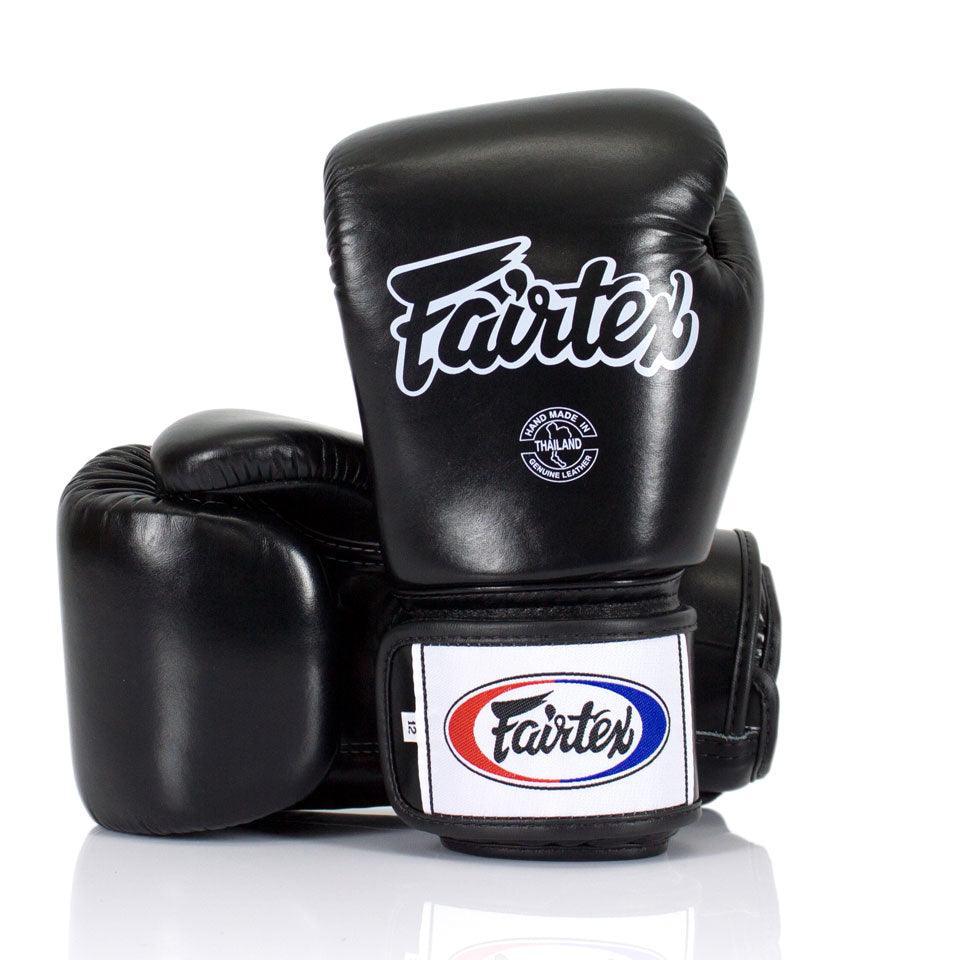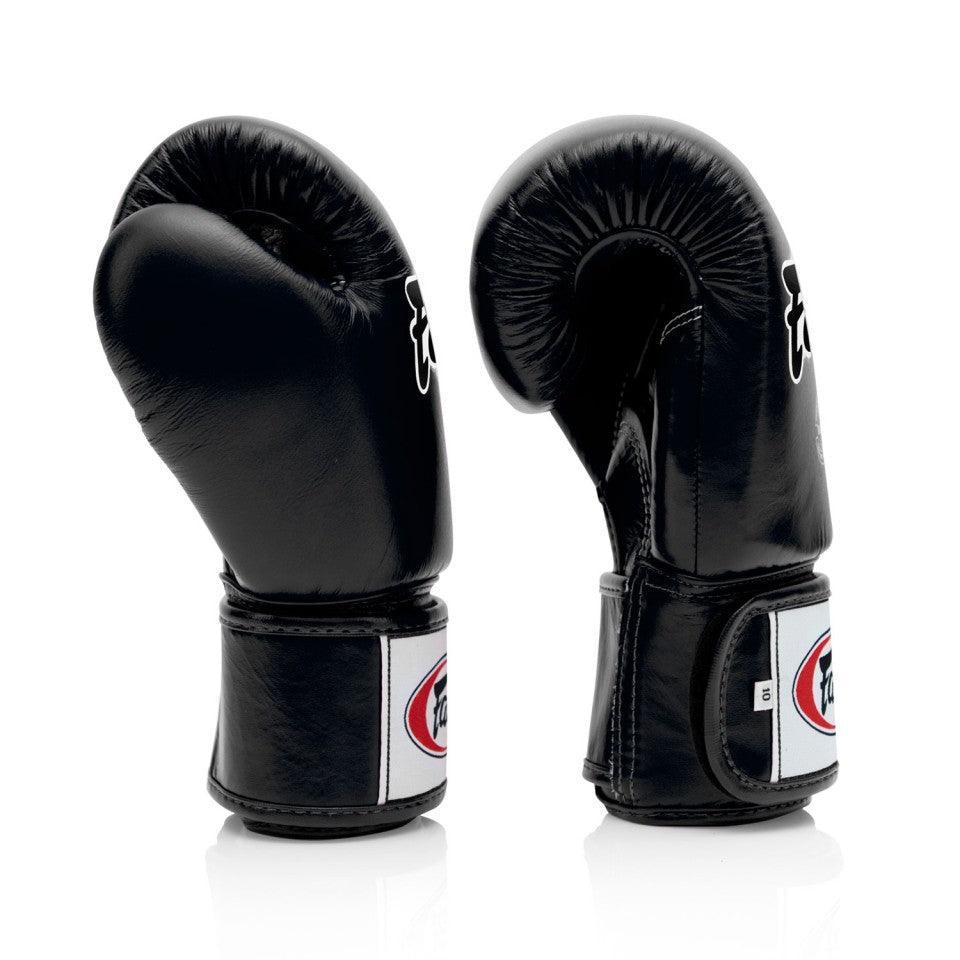

The BGV1 is the most widely used Muay Thai glove in the world and it deserves to be. Premium leather, Fairtex’s three-layer foam, a compact profile that lets you punch around a guard, and no internal grip bar — so your hand opens naturally for catching and clinching. It runs true to size, lasts years, and if you buy one pair of Muay Thai gloves in your life it should probably be this one.
That said, it's not perfect. The break-in is real, the short cuff braces the wrist less than others, and for hard sparring there are better options in Fairtex’s own range. This guide covers all of it.
Why the BGV1 is the benchmark
Walk into a Muay Thai gym anywhere in the world and you will find a pair. Hanging by the door, on the trainer’s hands, on the bag. That ubiquity is not marketing — the design has barely changed since the nineties because Fairtex got the shape right and then left it alone.
Fairtex have been making equipment since 1958, which makes them older than most of the brands they are compared against. The BGV1 is the model everything else in the category gets measured against, including by people who prefer something else.
What you are actually buying
Premium cowhide leather, hand made in Thailand, with Fairtex’s signature three-layer foam system which is built with a thin soft outer layer, a firm middle layer doing most of the work, and a thin inner layer against the hand.
The build details matter as they will take punishment through all your hard training. The stitching is clean and does not come loose. The inside carries no internal tags, so there is nothing to rub or scratch during a session. The velcro strap is the long-lasting kind and the patch on the cuff doesn't cause any scratches.
The most divisive feature is the one that is missing. There is no internal grip bar. Your hand opens easily, which makes catching kicks, framing and clinching feel natural. If you have come from boxing gloves you will notice its absence for a few weeks, and some people find themselves folding their fingers rather than making a proper fist until they adjust. Most people end up preferring it.

The fit: the thing that confuses most first time buyers
Reviewers contradict each other on this constantly. Some describe the BGV1 as tight and best suited to smaller hands. Others say the interior is generous and feels loose. Both are describing the same glove accurately.
The BGV1 is compact on the outside and roomier on the inside than its profile suggests. The dense foam keeps the external shape small — which is exactly why it punches so well around a guard — while the hand compartment itself has more space than you would guess from looking at it.
Practically, this means you need wrap your hands properly and use long wraps. Without them your knuckles do not sit where they should in the knuckle box, and the glove will feel hollow rather than locked in. With 4.5 m wraps it feels like a different glove. Browse the hand wraps collection to find the perfect pair of hand wraps that will ensure a proper fit.
Sizing itself runs true. Fairtex do not need sizing up and we do not recommend it. If you have genuinely large hands or wide knuckles, the compact external shape will feel restrictive and a roomier brand suits you better. Our Muay Thai gloves size guide covers measuring and how every brand compares.
The break-in period is real
Expect roughly two plus weeks of regular training before the leather softens. The first session can be uncomfortable and it is common to wonder whether you have bought the wrong glove.
It's likely you haven't. Leather moulds to the hand with use and a broken-in BGV1 fits like nothing else because it has shaped itself around your specific hand. People routinely report pairs four years old that are only just at their best. That is the trade you are making against a synthetic glove that feels good on day one and never improves.
Do not try to speed it up by soaking them. Just train in them.
The wrist question
This is where many reviews split their opinions most widely. Some rate the cuff highly and say it protects well when blocking. Others say wrist support is the BGV1’s clear weakness and advise anyone with wrist problems to look elsewhere.
The reason for the disagreement is what they are comparing it to. The BGV1 has a short cuff by design because Muay Thai requires the wrist to move freely in the clinch. Against a boxing glove or a long-cuffed model it braces less. Against another traditional Thai glove it is entirely normal.
So, if your wrists are the weak link in your training, this is not the glove for you, and no amount of wrapping fully compensates. Look at a longer-cuffed model — Fairtex’s own BGV14 or BGV9, Top King’s Kanok II, or Primo’s Emblem range if you want the most wrist support available. We cover the cushioned alternatives in our Fairtex vs Top King comparison and go through the Kanok II properly in our Top King buyer’s guide. If your wrists are fine, the short cuff is a feature and you will appreciate it every time you clinch.

The padding
The BGV1 is not a pillow. The foam is dense and firm, and it gives sharp feedback — you know when a shot landed properly. On pads and the heavy bag that is exactly what you want and it is why the glove suits technical work so well.
For hard sparring it is a fair criticism that the padding is thinner than ideal. It is worth understanding what you are protecting: the boxer’s fracture is a break to the fifth metacarpal neck caused by axial pressure through a clenched fist — precisely what happens when your knuckles are not sitting where they should be inside the glove. That is the whole argument for the knuckle box, and for wrapping properly.
If your gym spars hard and often, buy a plusher glove for partner rounds and keep the BGV1 for everything else. That is not a knock on the glove; it is how most experienced people run two pairs anyway. Our Twins Special buyer’s guide covers sparring alternative for many.
BGV1 vs BGV14: what changed
Buy the BGV1 for clinch work, feedback and a leather glove that improves with age. Buy the BGV14 if you want more wrist support, a roomier compartment, and a glove that performs identically from the first session to the last. The BGV14 is the better sparring glove; the BGV1 is the better Muay Thai glove.
| BGV1 | BGV14 | |
|---|---|---|
| Material | Premium cowhide leather | Microfibre |
| Cuff | Short — clinch mobility | Extended — more wrist and forearm support |
| Hand compartment | Compact profile, moulds over time | Pre-moulded, roomier, ready from day one |
| Break-in | About two weeks | Effectively none |
| Sweat | Leather absorbs it — gloves gain weight through a session | Repels moisture — weight stays constant |
| Maintenance | Needs airing and care; leather can crack if mistreated | No oiling, does not crack |
| Odour | Holds it more over time | Odour-resistant |
| Feel | Firm, direct, precise | Softer, more forgiving |
| Best for | Clinch, pads, bag, technical work | Sparring, bigger hands, weaker wrists |
The sweat point is underrated and one you should consider closely. Leather soaks up moisture across a session, so a leather glove is measurably heavier in round eight than in round one. Microfibre does not, which is why the BGV14 stays consistent through long sessions.
The counter-argument is that leather ages into something a synthetic never becomes, and lasts longer if you look after it. Neither is wrong. The BGV14 is the sensible pick for sparring-heavy training; the BGV14SB runs a longer cuff again if wrist support is the priority.
Where the BGV1 sits in the Fairtex range
Fairtex make a lot of gloves and the model numbers explain nothing. Here is the map.
| Model | What it changes versus the BGV1 |
|---|---|
| BGV1 | The benchmark. Leather, short cuff, compact, firm padding. |
| BGV1BR | The same glove with a mesh palm. Cooler hands. Fairtex themselves position it as the friendliest option for beginners. |
| BGV14 | Microfibre, longer cuff, roomier, pre-moulded. |
| BGV19 | Deluxe tight fit — a tighter compartment again, extra knuckle padding, and a more tucked-in thumb position. |
| BGV9 | Mexican profile. Flatter, harder padding, considerably longer cuff. A boxing glove more than a Thai one. |
| BGV11 | F-Day limited edition. Microfibre, long cuff, plusher, with collector packaging. |
| BGV25 | F-Day 2. Microfibre with a BGV1-like fit and a slightly longer cuff. |
| X ONE | The BGV1 in official ONE Championship colours. |
The colourways

A few practical notes because colour is not purely cosmetic on a glove that will be sweated into for years.
- Black — the default and the best seller. Hides wear and scuffing better than anything else. If you cannot decide, get this.
- Blue and Red — the classic gym colours. Red is the traditional Thai choice.
- White — looks superb for about a month. Shows every mark. Buy it knowing that.
- Yellow and Pink — stands out and easy to spot.
- Dark Cloud — a muted, understated finish for people who want something other than block colour.
- Thai Pride — Thai flag design. What's not to like?
Which oz should you buy?
16 oz if you spar, or if you are buying a single pair to do everything. Most UK gyms require 16 oz as a sparring minimum and a 16 oz BGV1 handles pads and bag work perfectly well.
10 oz or 12 oz for a dedicated bag and pad pair. This is where the BGV1 is at its best — the firm padding and sharp feedback are exactly right for technical work.
One thing worth knowing about handmade gloves: actual weights vary slightly from the label. A 16 oz pair may come in marginally over. That is normal and not a defect.
Who it suits, and who it does not
Buy the BGV1 if
- You clinch, frame and catch kicks — the open hand and short cuff are built for it
- You want feedback and precision on pads and bag
- You have small to average hands
- You want a glove that improves over years rather than degrading
- You are buying without trying a pair on — it runs true, which makes it the low-risk order
Look elsewhere if
- Your wrists are your weak point — the short cuff will not brace them enough
- You have large hands or wide knuckles — the compact profile will feel restrictive
- Your gym spars hard several times a week and you only want one pair
- You want a glove that feels perfect immediately — leather does not work that way
Making them last
Moisture kills gloves more than impact. Wrap your hands every session as wraps act as a sweat barrier as much as hand protection. Pull the gloves wide open after training and let air inside rather than sealing them in a kit bag. Keep them off radiators and out of direct sunlight, both of which crack leather.
Done properly, a BGV1 lasts years. Our guide to cleaning Muay Thai gloves covers the full routine.
One warning. The BGV1 is among the most counterfeited gloves in the sport. Treat any pair discounted 50% or more below RRP as suspect, and check the price across three or four retailers — genuine RRP is consistent. Everything we sell is sourced through authenticated channels.
FAQs
Is the Fairtex BGV1 worth it?
Yes, for pad work, bag work and clinch training. The leather is excellent, the shape is the benchmark, and a well-cared-for pair lasts years and improves as it moulds to your hand. The one job it does not do best is hard sparring, where the firm padding is thinner than ideal.
Does the Fairtex BGV1 run small?
It runs true to size and does not need sizing up. The external profile is compact because the foam is dense, but the hand compartment is roomier than it looks. Wrap properly with 4.5m wraps and it fits as intended. Large hands may still find it restrictive.
How long do Fairtex BGV1 gloves take to break in?
About two weeks of regular training. The first session can feel stiff and uncomfortable, which is normal for genuine leather. After that the glove softens and moulds to your hand, and many people find a pair is at its best after a year or more of use.
BGV1 or BGV14 — which should I buy?
The BGV1 for clinch work, feedback and a leather glove that ages well. The BGV14 for more wrist support, a roomier fit, no break-in and better sweat resistance. In short, the BGV14 is the better sparring glove and the BGV1 is the better Muay Thai glove.
Do Fairtex BGV1 gloves have a grip bar?
No, and that is deliberate. The absence lets the hand open naturally for catching kicks, framing and clinch work. People coming from boxing gloves notice it for a few weeks and then usually prefer it. If you want a grip bar, look at a Mexican-profile model instead.
What size BGV1 do I need for sparring?
16 oz. Most UK gyms set that as the sparring minimum, and it is the right single purchase if you are only buying one pair. For dedicated bag and pad work, 10 oz or 12 oz suits the glove better and keeps your sparring pair in condition longer.
Where to buy
Browse every BGV1 colourway alongside the rest of the Fairtex range. If you are still choosing between brands, our Fairtex vs Twins comparison puts the two most-asked-about options head to head.
Between sizes, or unsure whether the short cuff will suit your wrists? Send us your hand measurement and tell us how you train, and we'll give you an expert opinion.